


By David Maroto Carmona (ERNI Spain)
Quantum computing is often presented as a technology capable of changing everything. The reality is less ambitious: it will not replace today’s computers, but it may open up a new way of solving certain problems that are currently extremely difficult.
This is the first of two articles on quantum computing. In this article, we explain what a quantum computer really is, how it works and why it is considered such a revolutionary technology. In the second article, we will explore its potential practical applications in everyday life and its impact on fields where ERNI has significant expertise, including cybersecurity, artificial intelligence and healthcare.
Many of the concepts behind quantum computing are difficult to understand from the perspective of classical physics. Therefore, before delving into the details, it is worth taking a step back and looking at the origins of this remarkable technology.
From the atom to quantum computing
Quantum computing builds on a fundamental idea: at very small scales, nature does not behave in the way we observe in everyday life. For centuries, it was believed that matter could be fully explained by the laws of classical physics. However, the study of the atom and its constituent particles revealed that this view was incomplete.
At the beginning of the twentieth century, quantum physics emerged as a theory describing the behaviour of microscopic particles. It allows us to understand phenomena that do not align with our everyday intuition, such as superposition, entanglement, interference and decoherence.
These concepts may seem strange, but they are not magic. They are real and highly precise physical principles. It is exactly these principles that inspire quantum computing: a different way of processing information by harnessing nature’s most fundamental behaviour.
Decades later, scientists such as Paul Benioff, Richard Feynman and David Deutsch proposed a revolutionary idea: if nature operates according to quantum rules, perhaps a computer based on those same rules could solve certain problems more efficiently than a classical computer.
This gave rise to the concept of quantum computing.
A classical computer works with bits. Each bit can take one of two values: 0 or 1. All digital information, whether a piece of text, an image, an application or a web page, is ultimately represented as combinations of these zeros and ones.
A quantum computer, by contrast, works with qubits. A qubit can also produce either a 0 or a 1 when measured, but before that measurement takes place, it can exist in a richer state: a combination of possibilities.
This property is known as superposition.
Superposition: More than a 0 or a 1
Superposition does not simply mean that a qubit is “both 0 and 1 at the same time” in the everyday sense of the phrase. Rather, it means that its quantum state contains multiple possibilities, and that these possibilities only become definite when a measurement is made.
One simple way to visualise this is to think of a coin spinning in the air. While it is spinning, it does not clearly show either heads or tails. Only when it lands do we see a definite outcome. The comparison is not perfect, because a qubit is not a coin, but it helps illustrate the key idea: before measurement, the system maintains more than one possibility.
This capability allows quantum algorithms to process information in a fundamentally different way from traditional algorithms.
Entanglement: When qubits form a unified system
Entanglement is one of the most distinctive and fascinating features of quantum physics. It occurs when two or more qubits become linked in such a way that they can no longer be described independently. Instead, they form a single quantum system whose state must be considered as a whole. In an entangled system, the state of one qubit is directly related to the state of the others, regardless of the physical distance between them. This does not mean that information is transmitted instantaneously, but it does mean that the qubits share correlations that cannot be explained by classical physics.
Although entanglement may seem counterintuitive, it has been demonstrated experimentally many times and is a fundamental resource in quantum computing. By exploiting these quantum correlations, certain algorithms can perform calculations in ways that are not possible with classical systems.
Together with superposition, entanglement is one of the key principles that give quantum computers their unique capabilities.
Interference: Giving more weight to the right answer
The third key concept is interference. In physics, waves can reinforce or cancel each other out. When two waves meet in phase, they can combine to form a larger wave. When they meet out of phase, they can diminish one another or even cancel each other completely.
Something similar happens in a quantum system, but with probability amplitudes rather than physical waves. Quantum algorithms exploit the combination of superposition, entanglement and interference to increase the probability of correct answers while reducing the likelihood of incorrect ones.
In a classical computer, solving a complex problem often resembles a process of trial and error. It is like a mouse navigating a maze: it follows one path, reaches a dead end, turns back and tries another route, repeating the process until it eventually finds the exit.
A quantum computer behaves very differently. It is more like a cloud of smoke filling the entire maze at once. As the computation progresses, the paths that lead nowhere gradually fade away, while the route leading to the solution becomes increasingly reinforced. By the time the system is measured, the most promising path has been amplified, making it far more likely to produce the desired result.
The key is not that a quantum computer does the same thing as a classical computer, only faster. Rather, it takes advantage of different physical principles to solve certain problems in a fundamentally different way.
Decoherence: The great challenge
The main challenge facing quantum computing is that qubits are extremely fragile.
For a quantum computation to work, qubits must preserve their quantum properties for long enough to complete the calculation. The difficulty is that any unwanted interaction with the surrounding environment can disturb the system. Vibrations, heat, radiation and electromagnetic noise can all destroy superposition and entanglement.
This phenomenon is known as decoherence.
This is why many of today’s quantum computers require highly demanding operating conditions. Some technologies, such as superconducting qubits, function at extremely low temperatures, very close to absolute zero, around −273.15°C. At such temperatures, thermal noise is greatly reduced, helping the system maintain its quantum behaviour for longer.
Highly sophisticated isolation, shielding and control systems are also required. Building qubits is only part of the challenge. They must also be protected, manipulated and measured without destroying the information they contain.
Returning to the coin analogy, it would be like trying to keep a coin spinning indefinitely without anything touching it and without air resistance slowing it down. As soon as the environment interferes too much, the coin stops spinning and settles on a definite result. In a qubit, this loss of quantum behaviour limits its ability to perform quantum calculations.
More qubits do not simply mean “a bit more” computing power
One of the reasons this technology attracts so much interest is that adding qubits does not increase capacity linearly, but exponentially. A qubit can be described by the following formula:
∣ψ⟩=α∣0⟩+β∣1⟩
where α and β are complex amplitudes and satisfy
∣α∣^2+∣β∣^2=1.
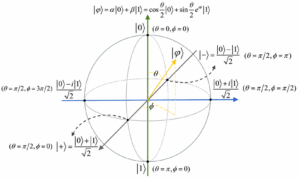
In simple terms, this means that before measurement, a qubit is not limited to a pure 0 or 1 state, but can encode a combination of both. When multiple qubits are combined, the mathematical space grows as 2ⁿ. Ten qubits represent 1,024 basis states, twenty exceed one million, and fifty surpass one quadrillion.
This is also the best way to understand the relationship with logic gates. In classical electronics, each additional bit increases the number of possible combinations, but the system still moves between well-defined states. In quantum computing, each additional qubit doubles the size of the state space on which quantum gates operate. This does not mean that the machine magically “tries all solutions at once”. Rather, it operates on a structure that grows far more rapidly, which is precisely what makes certain algorithms so promising.
Between current challenges and real potential
The challenges associated with decoherence show that quantum computing is still at an early stage of development. Nevertheless, these limitations do not diminish its relevance. Each advance in stability, isolation or error correction brings us closer to the reliable use of qubits and, with it, to tackling problems that are currently beyond the reach of classical computing.
Rather than replacing today’s computers, quantum computing represents a shift in perspective: transforming the quantum laws of nature into a technological tool capable of opening up a new category of solutions.
In the second part of this article, we will explore the practical applications and the future of this technology in more detail.