


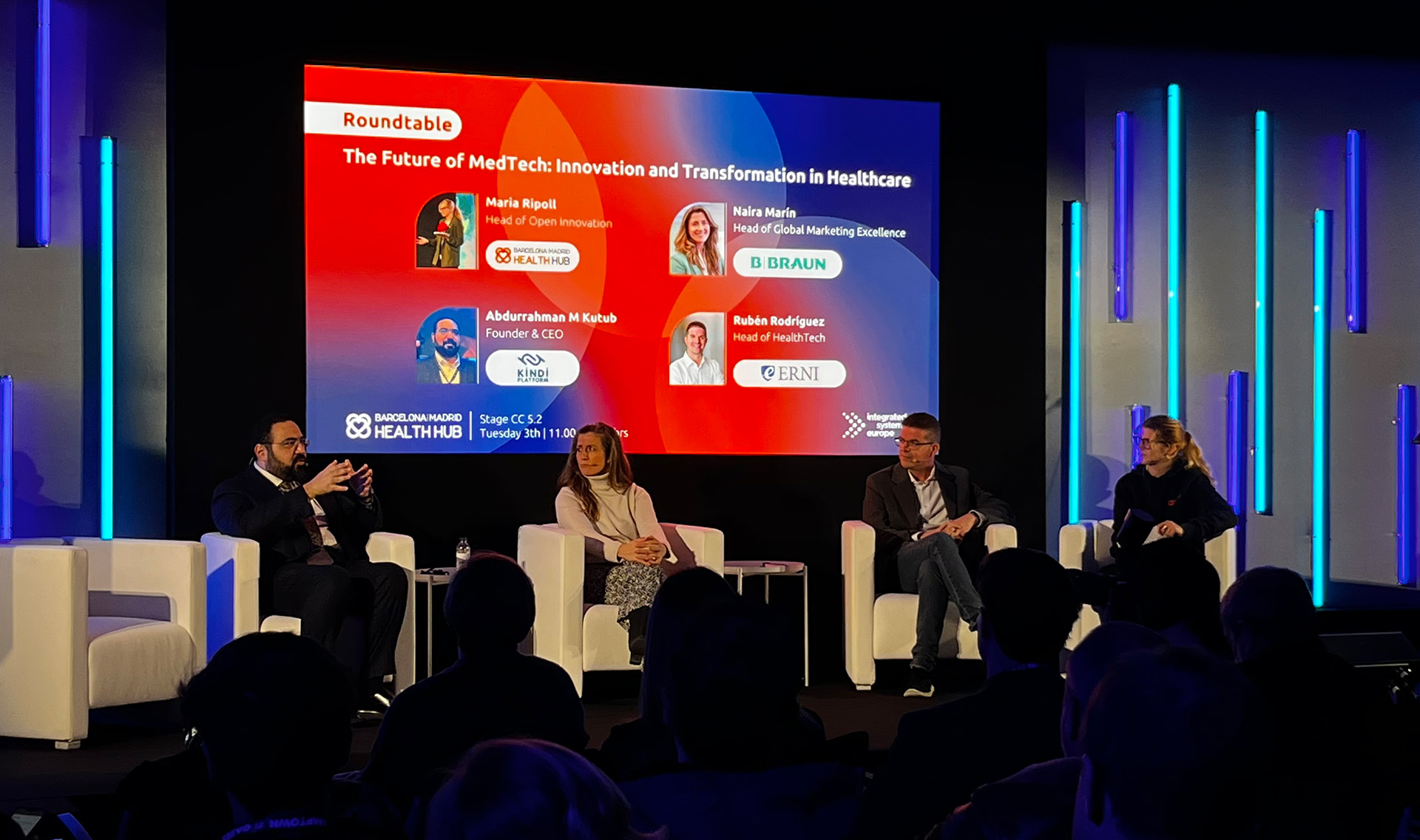
By Rubén Rodríguez (ERNI Spain)
Integrated Systems Europe (ISE) is one of the world’s most influential technology events. From 3 to 6 February 2026 in Barcelona, it brought together the global systems integration and audiovisual community to explore cutting-edge technologies, exchange expertise and discover new opportunities.
A global platform for technology and healthcare innovation
With more than 85,000 professionals, 1,600 exhibitors, and solutions spanning education, retail, corporate environments and live events, ISE provides a unique platform at the intersection of digital innovation, technology and real-world impact.
In 2026, ERNI Spain was once again part of this prestigious event, co-hosting a roundtable under the motto “The Future of MedTech: Innovation and transformation in healthcare.”
Redefining MedTech innovation in digital healthcare
Innovation in MedTech today goes far beyond new devices or standalone technologies. It increasingly encompasses digital health solutions, data-driven services and platform-based approaches that support clinicians and improve patient outcomes. Today, MedTech innovation is measured not just by technological advancement, but by its ability to deliver meaningful, scalable value – expanding access to healthcare and personalising patient care. The transformation itself is not driven by a single force, but by the interaction of several key factors.
Technology is a strong enabler, making new treatments, digital solutions and data-driven care models possible. Regulation sets the framework, ensuring safety, quality and trust, while at the same time influencing how quickly innovation can be adopted. Funding determines which innovations can be developed and scaled, shaping priorities across the system. Clinical demand provides the practical direction, as real needs from clinicians and patients ultimately define where technology delivers the most value.
While all these forces matter, the roundtable discussion showed that clinical demand has become the primary driver of innovation. Real needs from clinical practice are increasingly shaping new care models bottom-up, from everyday workflows to the technologies that support them.
From promising pilots to real-world impact in MedTech
Many MedTech innovations show strong potential in pilot projects but struggle to achieve large-scale adoption.

By addressing these factors from the start, MedTech companies can increase the likelihood that innovations move beyond the pilot stage and deliver measurable benefits across healthcare systems.
Nevertheless, healthcare organisations are no longer looking for isolated tools; they increasingly expect end-to-end, integrated solutions as fragmentation remains one of the biggest barriers to adoption and scaling digital health innovations.
Data, regulation and trust as enablers of digital health
Clinicians are not only interested in medical hardware, but increasingly in health data, insights and evidence that support better decision-making. They are mainly facing two major challenges:
- How to ensure trust, especially in a highly regulated, data-sensitive environment
- How to deal with interoperability, still one of the biggest blockers of digital transformation in healthcare
Data is the backbone of every healthcare system, not just a supporting element. It enables faster validation, adoption and scaling of MedTech solutions, and at the same time, high-quality, interoperable data is essential to build trust and demonstrate its value.
