



By Axel Taylor (ERNI Spain)
AI can now generate code faster than many organisations can define what that code should do. In the age of agentic AI software engineering, the challenge is shifting from writing code to directing, validating and maintaining work produced by humans and AI agents together. Spec-driven development offers a practical way to keep that speed aligned with business intent, technical constraints, testing and maintainability.
However, SDD is not a silver bullet. It does not remove the need for engineering judgement, product clarity or collaboration. Used badly, it can become just another documentation ritual. Used well, it turns AI speed into controlled, reliable delivery.
The new bottleneck is not code generation
For years, software delivery has been limited by how quickly teams could turn ideas into working code. AI is changing that equation. Modern AI agents can analyse requirements, plan changes, modify files, generate tests and run checks with increasing autonomy.
This is more than an advanced version of the AI copilot experience. In a copilot-style workflow, developers usually ask AI to support isolated tasks such as writing a function, explaining an error or generating a test.
Agentic AI software engineering changes the role of the team. Instead of asking AI to complete individual coding tasks, teams need to define the goal, boundaries, expected behaviour and validation strategy. Engineers remain responsible for direction, judgement, review and accountability.
The most valuable skill is orchestrating delivery so the output is aligned with business needs, architecture, security and quality expectations.
Specification becomes a control layer, not a bureaucracy layer
Spec-driven development, or SDD, is not new. Software teams have always been guided by requirements, acceptance criteria, architecture decisions and testable expectations. What is changing is their importance when implementation can be accelerated by AI agents.
In agentic software engineering, the specification becomes the control layer between human intent and machine execution: a shared reference for what needs to be built, why it matters and how success will be evaluated.
A useful specification does not need to be long or rigid. The goal is not to document everything before doing anything, but to make the next important change clearer, safer and easier to validate.
A practical SDD specification should answer five questions:
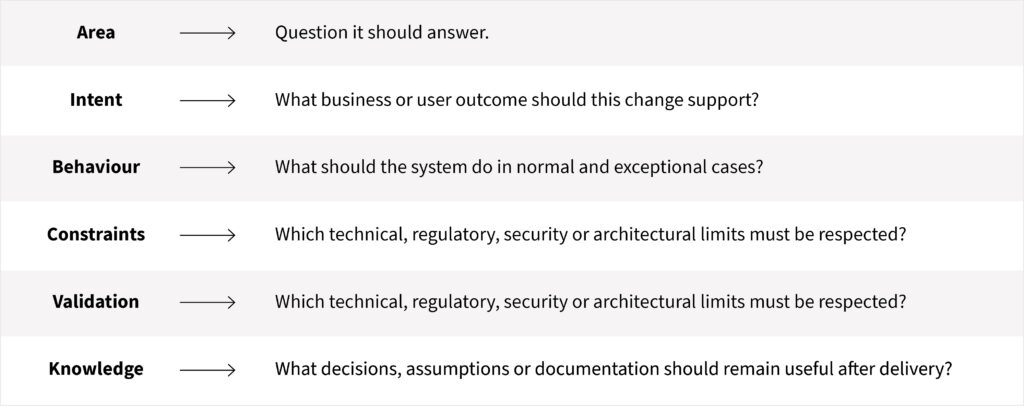
This makes the specification useful for developers, product owners, architects, QA engineers, security experts and AI agents.
From individual productivity to team orchestration
Many organisations are already using AI in software development. However, most adoption still focuses on individual productivity, while the broader delivery process remains largely unchanged.
That can create a dangerous illusion of progress. Faster code generation does not automatically mean better software. If the goal is unclear, AI can simply help teams produce the wrong solution more efficiently. Humanity has always been creative in finding ways to accelerate confusion.
SDD helps teams move from isolated AI assistance to structured engineering orchestration. Before implementation starts, the team defines the target outcome, affected systems, business rules, quality expectations and validation approach. AI agents get a clearer brief, and reviewers get a concrete reference for judging the output.
This changes the conversation from:
“Can AI generate this code?”
to:
“Have we defined the right outcome clearly enough for humans and AI agents to build and validate it?”
That shift is essential for teams and organisations that want to use AI beyond experimentation.
Why SDD matters beyond implementation
The value of SDD is not limited to writing better code. A good specification becomes a delivery asset across development, testing and documentation.
For development, it reduces ambiguity. Engineers and AI agents can understand what the feature should do, which systems are affected, which constraints apply and which edge cases matter.
For testing, acceptance criteria, business rules and edge cases can become unit tests, integration tests, regression checks, exploratory testing charters or test prompts for AI agents. In agentic workflows, tests are not only a quality check after implementation; they help constrain what the agent should produce.
For documentation and onboarding, SDD preserves the connection between why a change was needed, how it was implemented, how it was tested and how it should be maintained. The faster systems change, the more dangerous documentation drift becomes.
Where SDD can go wrong
Like any methodology, spec-driven development creates value only when adapted to the team and context. It can fail when teams treat specifications as documents to complete rather than tools to guide delivery.
There are several common risks. The first is over-documentation: if every small change requires a heavy specification, teams will avoid it or complete it mechanically. The second is false confidence: a specification can describe the wrong thing very clearly. SDD improves alignment, but it does not replace discovery, feedback or architectural review.
The third is poor maintenance: specifications created at the beginning and then abandoned quickly become outdated. The fourth is weak validation: a specification disconnected from tests, reviews or acceptance criteria may describe intent, but it does not prove that the intent was met.
For SDD to work, teams need discipline, but not ceremony for its own sake. The specification should be just detailed enough to reduce ambiguity, guide implementation and support validation.
SDD is not only for greenfield projects
A common misconception is that spec-driven development only works when starting a new product. In practice, many organisations need to introduce it into systems that are already in production.
That is possible, but not automatic. Brownfield adoption needs more care because the team is not only defining future behaviour; it is also discovering and respecting existing behaviour.
In existing systems, the value of SDD depends on the context. Some products have clear architecture, reliable tests and strong domain knowledge. Others have implicit business rules, fragile integrations, weak documentation or important knowledge held by only a few people. In those cases, SDD must start with understanding the current system.
This is especially important when AI agents are involved. If the codebase is difficult to understand, poorly structured or missing key documentation, an agent can amplify existing problems instead of solving them. A specification gives the team a better control layer, but it does not magically fix poor code quality, unclear ownership or missing product knowledge.
For that reason, SDD usually works best in brownfield environments when introduced selectively: new features, high-risk changes, unclear modules, complex integrations, recurring regressions or areas where AI agents need stronger context.
A practical adoption sequence could look like this:
- Understand the current architecture, dependencies, business rules and risks.
- Start with one bounded change, such as a new feature or risky integration.
- Define a lightweight template for intent, behaviour, constraints, validation and knowledge.
- Connect acceptance criteria and edge cases to automated or manual checks.
- Keep specifications close to delivery and improve them after each iteration.
Over time, these specifications can become a living knowledge base for the product, giving teams more clarity and control without stopping delivery.
A simple SDD workflow for a new feature
Imagine a team adding notification preferences to an existing customer portal.
In a traditional copilot-style workflow, a developer might ask an AI tool to generate a settings screen, add backend logic and create tests. That may produce a quick first version, but important questions can remain unresolved. Which communication channels are supported? What happens if a user withdraws consent? Which notifications are mandatory?
In an SDD workflow, the team starts with a lightweight specification. The intent could be that users can manage optional communication channels in the customer portal. Behaviour could define whether users can enable or disable email, SMS and push notifications. Business rules could state that mandatory security notifications cannot be disabled, while constraints could require consent changes to be stored for audit purposes.
Once this specification exists, an AI agent can analyse the codebase and propose the components likely to be affected. The team reviews that proposal and refines the specification with technical constraints, security considerations, migration needs and test scenarios.
The AI agent can then generate an implementation plan and initial code changes. Developers review the output against the specification, architecture principles and security requirements. QA engineers use the acceptance criteria and edge cases to guide tests.
At the end of the workflow, the specification becomes part of the project knowledge base, helping future developers and AI agents understand what was built, why it was built and how it should behave.
Helping teams adapt to agentic AI software engineering
For many organisations, the challenge is not adopting another AI tool or methodology. It is redesigning delivery around clearer intent, stronger validation and better team orchestration.
Spec-driven development helps teams make that transition by connecting business goals, technical decisions, implementation, testing and documentation into one workflow. In ERNI projects and advisory work, this structure is especially useful when teams need to connect business priorities, engineering constraints and responsible AI adoption without slowing delivery to a halt.
At ERNI, we help teams move beyond isolated copilot-style AI usage towards structured agentic AI software engineering. This includes defining practical SDD workflows, adapting them to existing systems, selecting suitable tools, and training teams to orchestrate AI agents responsibly.
The goal is not to replace engineering judgement with automation. It is to strengthen delivery by combining human expertise, clear specifications, reliable validation and the productivity of AI agents.
In the agentic software engineering era, successful teams will not be the ones that simply generate the most code. They will be the ones that can specify the right outcomes, guide AI agents effectively and validate that what is delivered truly serves the business need.
