


by Javier Hernández (ERNI Spain)
A familiar pattern plays out in growing products: delivery slows down, maintenance costs rise, quality becomes harder to protect. The roadmap fills up, but confidence in what should happen next gets weaker, not stronger. Customers feel it too: releases become less predictable, new features create new friction, teams spend more time working around complexity than removing it. Trust in the product starts to erode, even when the organisation is investing heavily in it.
This is often diagnosed as a delivery problem. The conclusion is that engineering is too slow, the teams are not strong enough, or the organisation needs different talent. Sometimes those things are true, and often they are not the root cause. In many cases, the deeper problem is fragmented product governance.
What product governance means in practice
In plain English, product governance is how an organisation makes product decisions: who decides, what information is used, how trade-offs are discussed, and how different functions stay aligned. When governance is weak, decisions still get made. They just get made inconsistently, reactively, and from different parts of the business pursuing different goals. That is why product decline can be misread. The symptoms show up in delivery, but the causes often sit upstream in leadership, structure and decision-making.
Why fragmented governance creates product decline
In many companies, accountability for the product is spread across several areas. R&D is responsible for building and maintaining the product. Sales is focused on winning revenue and opening new markets. Operations and support deal with customer issues and service pressure. All of these perspectives are legitimate. The problem starts when they are not connected by a clear product strategy and a consistent way to make trade-offs, and decisions are driven by local urgency rather than shared direction.
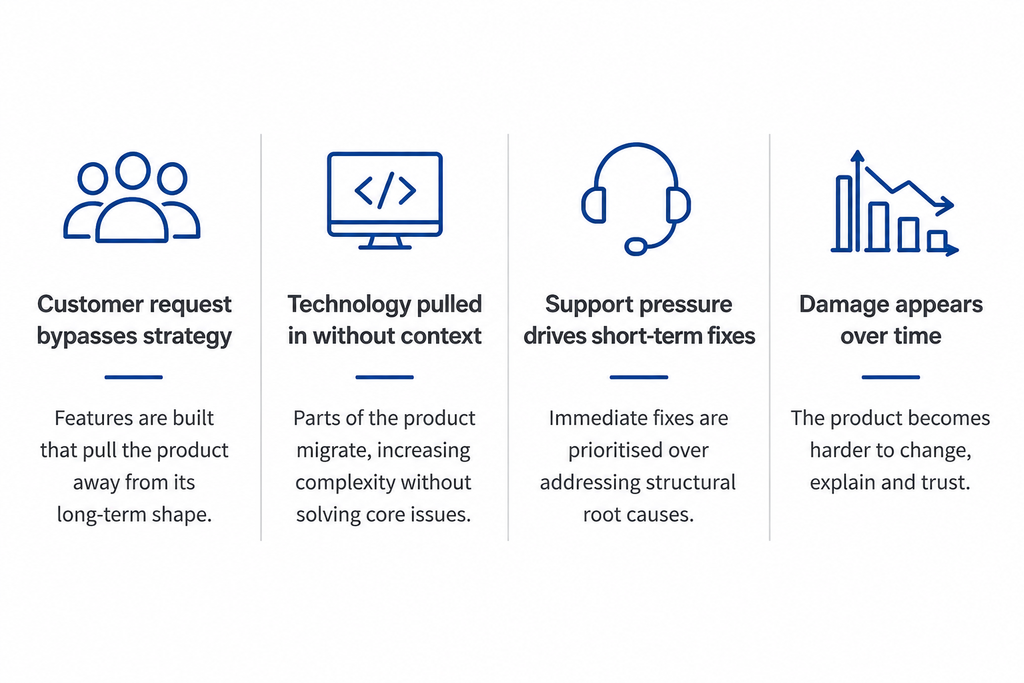
A large customer asks for a feature that could unlock a new market. The request goes straight into development, even if it increases complexity or pulls the product away from its long-term shape. A new framework or technology looks promising. Parts of the product start moving towards it, even though the underlying architecture is already hard to maintain and more urgent issues remain unresolved.
Support pressure rises. Teams prioritise immediate fixes without addressing the structural causes behind recurring problems. None of these decisions look unreasonable on their own. The damage appears over time, when the product becomes harder to change, harder to explain and harder to trust.
Why this is not just a product management issue
It is tempting to frame this as a product management gap and assume the answer is simply to appoint a product manager. Clear product ownership does matter – someone must have accountability for strategy, priorities and the roadmap.
But governance is bigger than one role; a strong product manager cannot compensate for a leadership system that rewards conflicting behaviours, tolerates unclear priorities or makes strategic trade-offs too late. For product and engineering leaders, this matters because governance shapes the environment in which delivery happens. Teams do not just inherit requirements. They inherit the quality of the decisions behind those requirements. If the organisation sends contradictory signals, delivery becomes reactive by design.
What better governance changes
Better governance does not remove complexity; it creates the conditions to handle it deliberately. That usually starts with three things:
- Clear ownership. There should be visible accountability for product direction, including how roadmap decisions are made and how trade-offs are escalated.
- Shared strategic criteria. Commercial opportunity, customer impact, technical sustainability, operational consequences, etc. should all be part of the same conversation, not separate ones.
- A decision-making rhythm. Governance only works when there are regular forums and practical routines that connect leadership intent with delivery reality.
When those elements are in place, the discussion changes. A request for a market-specific feature is no longer judged only on revenue potential; it is also assessed against product strategy, architectural impact, opportunity cost and the effect on existing customers.
Interest in a new technology is no longer an automatic trigger for partial migration; it is the trigger to understand what problem it will solve and what we need to do before running a small, useful experiment. That is the value of governance: it turns reactive decisions into informed ones.
A better starting point
When products begin to lose coherence, the answer is not more process, more pressure or a new wave of delivery targets. The better starting point is to clarify how product decisions are made across the business. We need to ask our organisations questions like: Who owns direction? How are trade-offs discussed? Which decisions are strategic, and which are simply reactions to the loudest signal in the room?
For leaders responsible for product direction, this is not an abstract governance exercise – it directly affects delivery speed, product quality, cost and customer trust. There is no single model that fits every organisation; the right setup depends on the product, the market and the operating context. And the principle is consistent: if decision-making is fragmented, product decline should not be treated as a talent problem first. It should be treated as a governance problem worth fixing.
For organisations working through this challenge, the role of a partner such as ERNI is not to impose a universal model, but to help define a governance setup that fits the business context, improves information flow and supports better product decisions over time.
