


by Hendrik Richter (ERNI Switzerland)
AI now writes code, generates tests and runs them in a single session. For quality assurance, this is not the end of a discipline. It is the moment QA moves from the end of the pipeline to the centre of the delivery system.
Ask experienced testers about the night before a major release and many will describe it like this: a regression suite that takes hours to run, selectors broken by a late UI change, and the nagging worry that something important slipped through. It is work done with great care, often under pressure and rarely seen in the spotlight. AI is about to change that scene, and for the better.
In the 2025 DORA research, 90% of technology professionals reported using AI at work. Across Europe, the share of enterprises with ten or more employees using AI technologies rose from 13.5% to 20% within a single year, and reached 55% among large enterprises, according to Eurostat.
The same DORA report describes AI as an amplifier: it magnifies the strengths of teams with clear workflows and fast feedback loops. In software delivery, few capabilities shape those feedback loops as directly as testing. Organisations that rethink QA for the age of AI are therefore not just catching up. They are building the foundation that lets every other AI investment pay off.
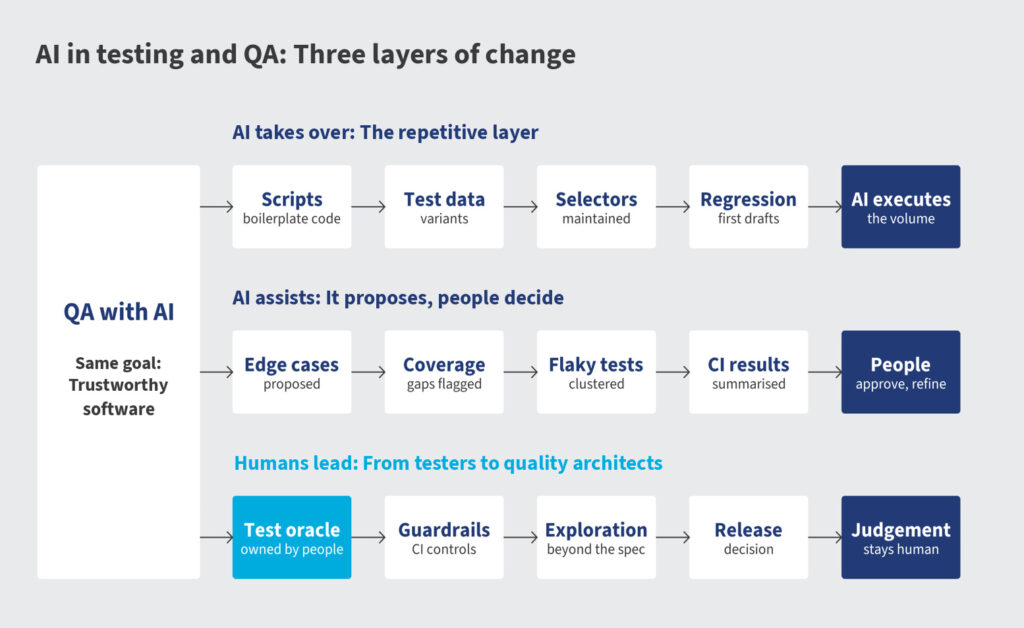
So what actually changes? In our client projects, we see three distinct shifts: work that AI takes over, work where AI and people collaborate, and work that becomes more human than ever.
Where AI takes over: The repetitive layer of testing
Let us be clear: some testing tasks will move to AI, and that is good news. Writing boilerplate test scripts, translating approved scenarios into automation code for an existing framework, generating test data variants, maintaining selectors after a UI change and producing first drafts of regression suites are tasks where agents are already faster and more consistent than people.
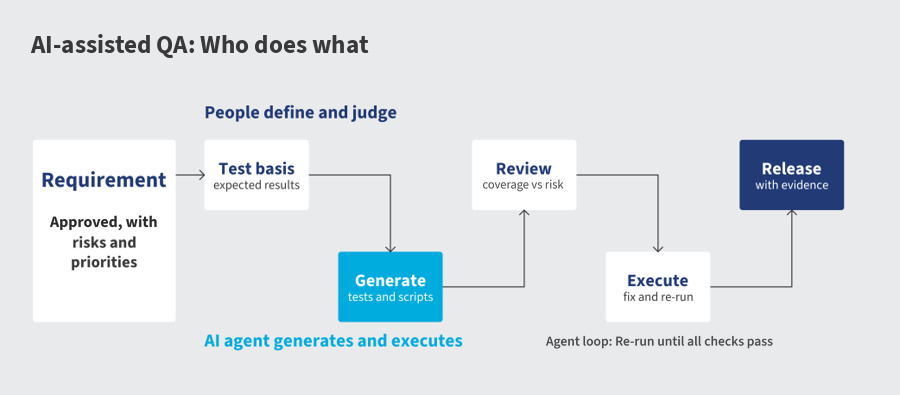
In ERNI projects, Claude Code generates test cases together with the corresponding scripts for the project’s own automation tools, aligned with its framework versions, fixtures and conventions. The time saved in preparing test artefacts is substantial. Agents can also run checks, read failures and correct their own output in a loop, which turns executable tests into a steering mechanism for implementation rather than a final gate.
Across development tasks more broadly, three randomised field experiments with 4,867 developers found that AI assistance increased completed tasks by around 26%. [4] For QA teams, this means the hours once spent on scripting and maintenance can be reinvested where they create far more value.
Where AI assists: A sparring partner for test design
The second layer is collaboration. Here AI makes skilled testers faster and more thorough without replacing their judgement. An agent can analyse a requirement and propose boundary conditions, rejection paths and edge cases a busy team might overlook. It can map test coverage against requirements and risks, flag gaps and suggest where mutation testing would reveal weak assertions. It can summarise CI results, cluster flaky tests and point investigators to the most likely cause.
The pattern that works is simple: AI proposes, people decide. Instead of drafting every scenario by hand, a tester reviews and sharpens a broader set in less time, and gains hours for exploratory testing. For many testers, this gives back the part of the craft that drew them to it in the first place: thinking like a curious user and finding what nobody expected. In our projects, the best results come from teams that treat the agent as a capable junior colleague, with clear instructions, defined boundaries and a reviewer who knows the domain.
Where humans lead: From test executors to quality architects
Here lies the insight we consider most important. When generating tests becomes cheap, the scarce resource is no longer test execution. It is knowing what the right answer is.
Every test compares behaviour with an expected result, which testers call the test oracle: an approved business rule, a reference calculation, an interface contract. If an agent misreads a requirement and uses that same reading to write both the code and its tests, everything passes and nothing is proven. The most valuable QA asset in an AI-assisted team is therefore not the script. It is the independently verified expected result, owned by people who understand the business.
This redefines the role rather than diminishing it. Testers become the people who clarify intended behaviour before a line of code exists. Automation engineers design the guardrails, CI controls and evaluation sets that keep agents honest. Test managers decide where evidence is sufficient for release. Exploratory, usability, security and performance testing gain weight because they ask questions no requirement anticipated. QA no longer sits at the end of the line checking output. It shapes the instructions and feedback that guide development itself. This is a role with more responsibility, more visibility and, for many, more meaning.
What makes AI-assisted QA work in practice
The organisations that move from pilot to scale share a handful of habits. They define the test basis first: requirements, interface contracts and risk priorities, with expected behaviour resolved before any test is generated. They protect approved acceptance tests from unreviewed edits, so an agent can never make a failure disappear by weakening the assertion. They enforce required checks through repository controls and CI rather than relying on instructions alone. And they measure value across the complete task: time to produce reviewed, executable tests, number of escaped defects and suite stability, not the number of generated test cases.
This approach scales even into regulated environments. In a recent medtech project, ERNI designed an AI-assisted QA workflow in which every approved requirement and risk control was traced to its test case, executable script and result for an identified build. Test data versions, toolchain configuration, prompts and model identifiers were recorded, so the evidence remained audit-proof for notified bodies. A repeatable evaluation set confirmed that each model or workflow change still produced valid test designs before it was rolled out. The result: substantial time savings in test preparation, while fully meeting the project’s quality and compliance requirements.
Quality becomes a strategic capability
AI will take over a significant share of the mechanical work in testing, and it will make skilled testers markedly more effective in much of the rest. What it will not do is decide what correct means for your business, your users or your regulator. That responsibility moves to the centre, and with it the people who carry it. The tester who once spent the night before a release worrying becomes the person the whole team trusts to say: this is ready.
The question for technology leaders is therefore not whether AI will change QA. It is whether your quality engineering is ready to become the amplifier that makes AI-assisted delivery fast and trustworthy at the same time.
If you are exploring how AI can accelerate testing in your organisation, ERNI’s quality engineering experts can help you design a workflow that fits your architecture, toolchain and regulatory context. A good place to start is one recurring testing task, taken all the way to reviewed scripts and execution evidence. Talk to us.